


Does Your Early Environment Shape Your Health?
I want to help you start thinking about your health in a different way — as a dynamic process shaped by multiple influences, some of which you can control or change.
By shifting towards a more preventative approach to health, rather than waiting until something goes wrong, you can start to take a more active role in how well your body adapts to the inevitable ups and downs of life. The aim is to remain healthy, energised, vibrant and resilient, so that you can continue to fully embrace life at every stage.
This is at the heart of the emerging science of longevity and healthy ageing. It isn't simply about living for longer. It's about living well for longer.
In this blog we will explore the impact of our early childhood environment on our health in later life.
Looking at your health through a new lens
Last week I introduced The Energy Map, a simple framework that helps us understand some of the influences that shape our lives and how we adapt, recover and recalibrate in response to our experiences.
Because our capacity to adapt and recover is an important part of what shapes our health over time.

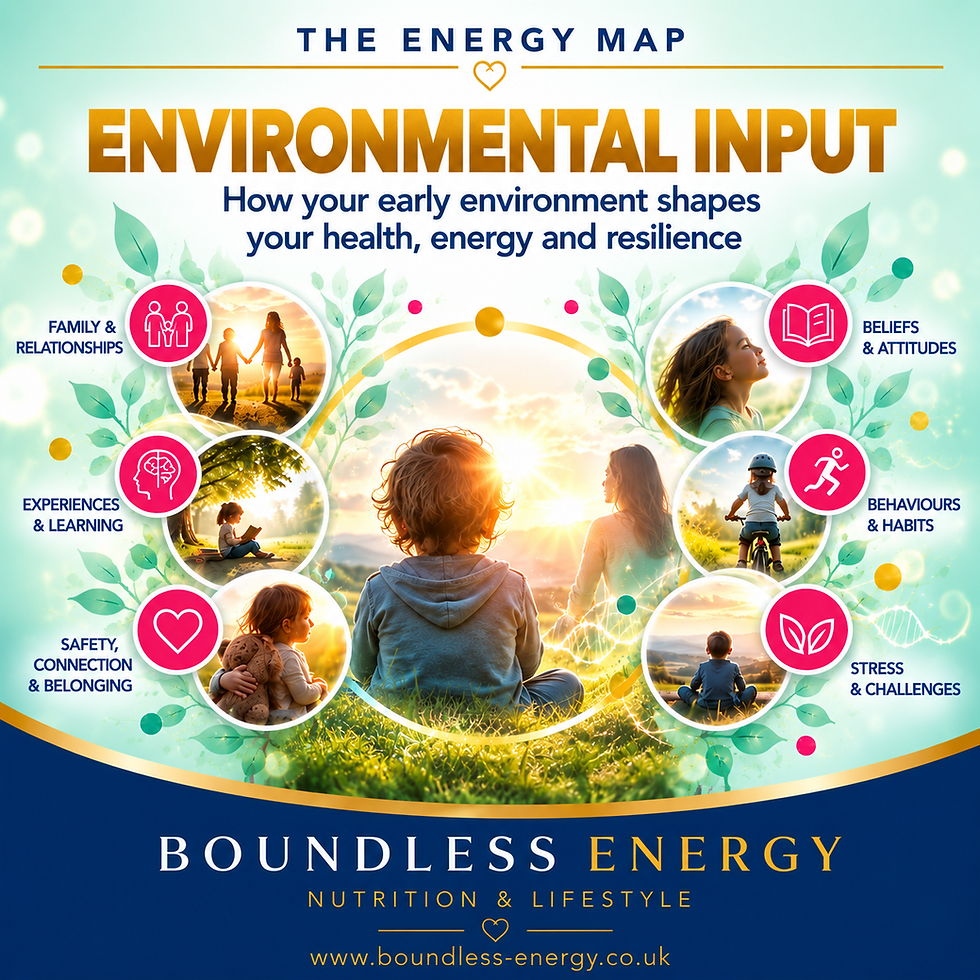
The Energy Map: Environmental Input
This week I want to start at the top of the Map with one of the environmental influences that can easily be overlooked: the developmental environment in which we grew up.
In my Hidden Drivers series, we looked at some of the more physical environmental inputs — such as the food we eat, the water we drink, or the chemicals and pathogens we're exposed to. But our environment is much bigger than that.
From the very beginning of life, we are continually responding to the world around us. Light, temperature, food, movement and microbes are all part of that environment. But so are our relationships, family life, social circumstances and our experiences of stress, safety, connection and belonging.
And these influences don't necessarily disappear once an experience has passed. Some can help shape how we think, feel, behave and respond to the world in the future.
Our environment provides information
One of the ideas at the heart of The Energy Map is that our environment is continually providing information to our body.
Sunlight helps tell us what time of day it is. Food triggers metabolic and hormonal responses. Exercise provides a challenge that encourages the body to adapt. An infection activates the immune system. A stressful experience can trigger changes throughout the nervous, hormonal and immune systems.
Our body detects what is happening around us and responds. But some of our earliest environmental influences arrive while our brains and bodies are still developing.
The early environment we grow up in matters to our health
As children, we learn from the world around us. We learn from what we experience, what we see other people doing, what we're repeatedly told and how the people around us respond to us.
Over time, those experiences can contribute to our expectations, beliefs, behaviours and ways of responding to different situations. They can also influence our developing stress-response systems.1
This doesn't only apply to extreme childhood adversity. Everyday family and social environments can shape our attitudes towards food, exercise, sleep, emotions, work, relationships, ageing and even what it means to be healthy.
Some responses can become so familiar that we carry them into adulthood without consciously recognising where they came from.
This is sometimes described as developmental programming— the idea that experiences during important periods of development can help shape how our biology and behaviour responses later in life.
The science behind this is complex, but the underlying principle is increasingly well recognised: our early environment can influence our later health.2
And importantly, influence doesn't mean destiny.
Environment has an energetic cost
The environments we experience influence what our bodies repeatedly have to respond and adapt to. And adaptation requires energy.3 This is why Energy sits at the centre of The Energy Map. Every response our body makes requires resources.
Think about stress. If something feels threatening, your body prepares you to respond. Your heart rate may increase, glucose can be made more readily available, your attention changes, digestion may temporarily become less important and resources are redirected towards dealing with the immediate situation.
That's useful when we need it. But repeatedly mobilising those resources without enough opportunity to recover is very different from responding briefly and then returning to balance.
This is one reason energy and resilience are so important when we think about healthy ageing.
It's not simply about the challenges we encounter, but how effectively we can respond, recover and adapt to them throughout life.
We continue to change
None of this means that our childhood environment determines how healthy we will be as adults.
We continue to learn and adapt throughout life. New experiences can change old patterns. Our environments can change. Our behaviours can change. And understanding some of the influences that have shaped us gives us an opportunity to respond differently.
That's one of the reasons I've developed The Energy Map. It encourages us to look beyond individual symptoms or health behaviours and consider the wider pattern:
What has my body been responding to throughout my life, and how might that be influencing my health today?
So what can you do now?
You don't need to analyse your entire childhood or overhaul your life. For now, simply start by broadening what you think of as your environment.
Notice what happens to your energy in different situations. What leaves you feeling energised and engaged, and what consistently drains you? How quickly do you recover after a stressful day? Are there particular situations that seem to trigger a stronger response than you might expect? What happens to your sleep, digestion, appetite or energy when you're under pressure?
And perhaps start noticing some of the messages you've carried with you, such as:
I should always be productive.
Rest is lazy.
I have to cope on my own.
I can't let people down.
This is just what happens as you get older.
You don't have to change any of them yet. Just notice.
Because something in our environment doesn't automatically determine how our body responds to it. Between the input and the response, something very important happens: we interpret it.
And that's where we'll go next, exploring why two people can experience the same situation very differently and how previous experiences, conditioning and beliefs may influence what happens next.
Follow The Energy Map
If you'd like to follow my exploration of The Energy Map and discover practical ways to support your health, energy and resilience, sign up to my Health Insights newsletter, and I'll send the latest articles and insights directly to your inbox.
Join Health Insights: Click here to keep updated!
Evidence Sources
Niu L, et al. (2025). Association of childhood adversity with HPA axis activity in children and adolescents: A systematic review and meta-analysis. Neuroscience & Biobehavioral Reviews, 172, 106124.
Berens AE, Jensen SKG, Nelson CA III. (2017). Biological embedding of childhood adversity: from physiological mechanisms to clinical implications. BMC Medicine, 15, 135.
Zitkovsky EK, Daniels TE, Tyrka AR. (2021). Mitochondria and early-life adversity. Mitochondrion, 57, 213–221.


Comments